Nguyen Van Cuong
-
Party

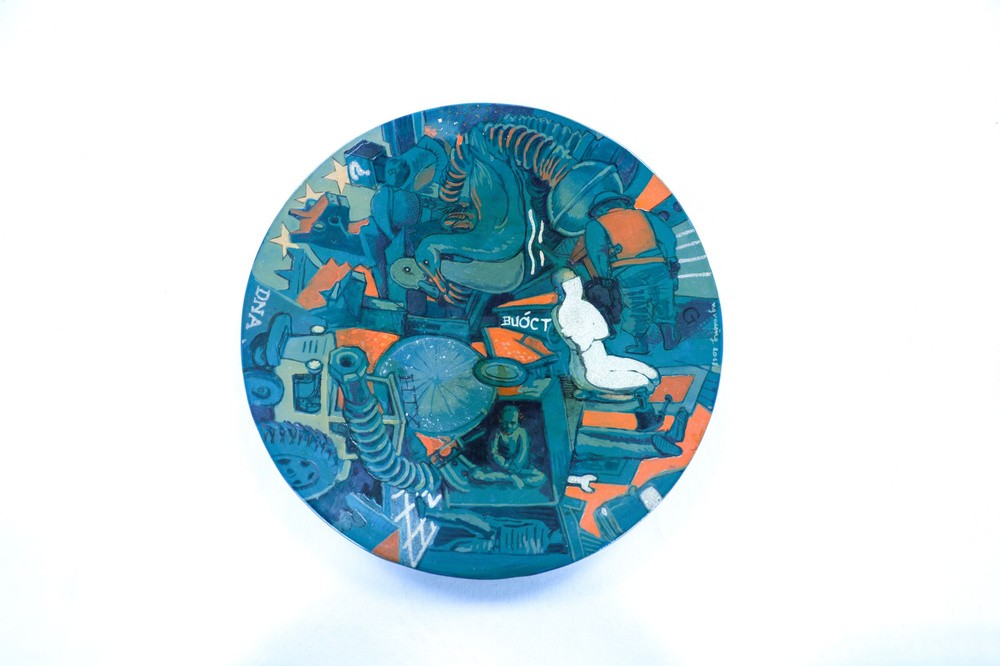
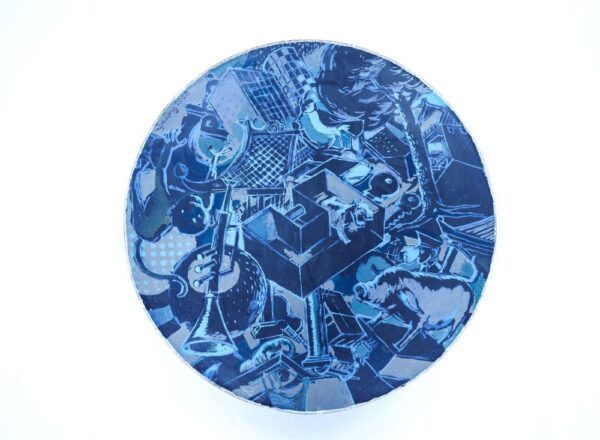
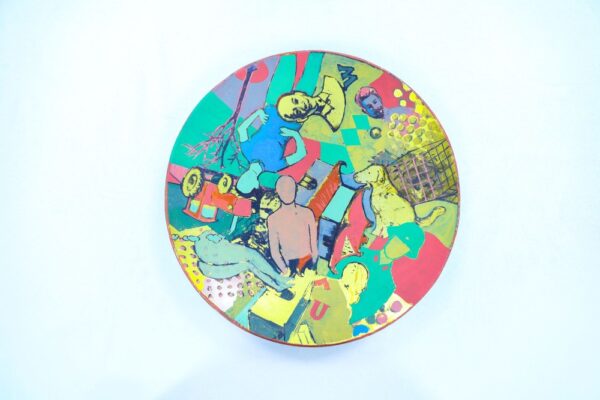
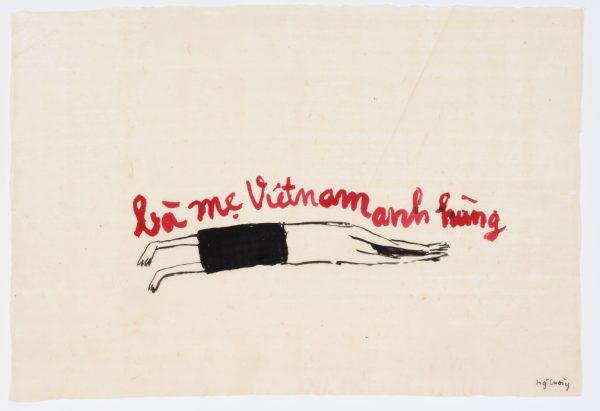
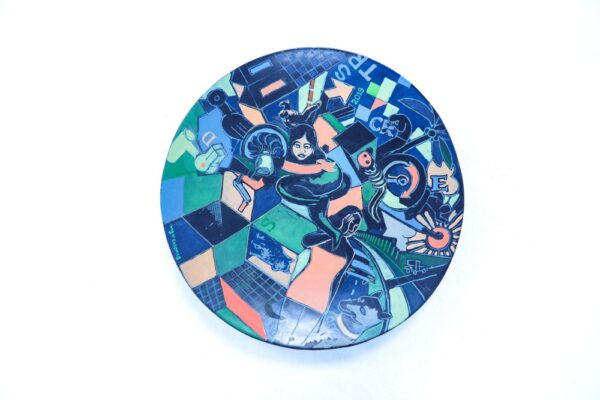
Across his works on paper and in lacquer, Nguyen Van Cuong articulates a form of critical realism that resists both academic convention and mainstream aesthetics, foregrounding the abject as a necessary mode of representation for capturing the psychic and social dislocations of a society in transition.
Central to Cuong’s practice is the development of a lexicon of recurring images that both carry personal weight and evoke the contradictions of post-Đổi Mới (Renovation) Vietnam. Suited men without mouths become symbols of bureaucratic authority – figures endowed with power but stripped of voice or substance. Groups of howling men cheering in unison at whatever those in power proclaim, eager for a seat at the table. Equally prominent are his depictions of naked – decisively naked, not classically nude – women whose bodies are transformed into grotesque instruments. In some works, their nipples extend into rubber tubing that nourish men as they drink, sing karaoke, or conduct business.
Rather than organize his compositions around narrative coherence, Cuong adopts an accumulative strategy, filling the pictorial plane with disjointed objects and zombie-like figures. Everyday technologies – vacuum cleaners, hair dryers, televisions, and computers – appear alongside industrial remnants such as pumps, wrenches, pipes, and loudspeakers. This juxtaposition of pre- and post-Đổi Mới machinery creates a dissonant inventory of Vietnam’s transitional economy: proletarian tools linger as nostalgic residues, while modern devices function as life-support mechanisms, literally sustaining his dehumanized characters. Here, Cuong collapses boundaries between consumption, exploitation, and sexuality, underscoring the entanglement of gendered bodies within patriarchal structures and capitalist desire. These motifs, while rooted in local realities, resonate with broader global critiques of political corruption and social dysfunction.